TL;DR
- AR trains in context: digital guidance overlaid on real equipment, in the real workplace, often on devices workers already carry.
- VR trains without consequences: a full simulation where mistakes are free, rare events are repeatable, and location doesn't matter.
- Rule of thumb: if the risk lives in the task, choose VR to practice it safely; if the risk lives in forgetting a step, choose AR to guide it live.
- MadXR's published range for custom VR training is $30,000–$60,000; AR guidance costs hinge on content authoring and existing devices.
- Mature programs sequence both: VR to build competence before touching real equipment, AR to reinforce it on the floor.
"Should we do AR or VR training?" is one of the most common questions we field, and it's usually asked as if the two were competing brands of the same product. They aren't. They solve different training problems, fail in different ways, and cost money in different places. The right choice falls out quickly once you ask the question properly: where does the risk in this job live?
Two Technologies, Two Different Promises
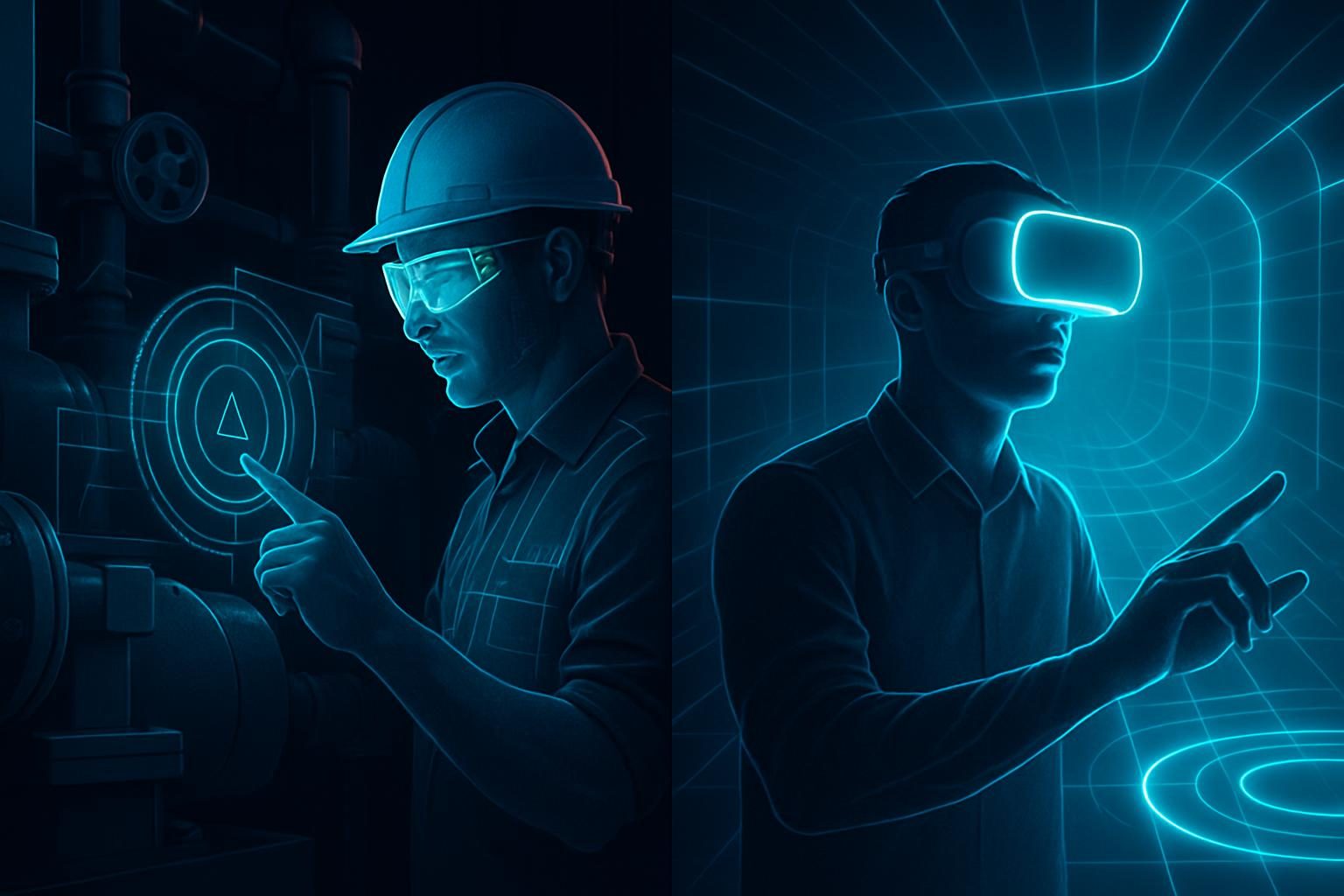
Augmented reality keeps the trainee in the real world and adds a digital layer to it: step-by-step instructions pinned to the machine being serviced, torque specs floating beside the bolts they apply to, warnings anchored to the components that bite. The workplace is the classroom. We cover the deepest industrial version of this in AR work instructions for manufacturing.
Virtual reality removes the real world entirely. Inside the headset is a simulated substation, operating room, cockpit, or angry customer — an environment where the trainee can do the dangerous thing, botch it, watch the consequences, and try again. No downtime on real equipment, no exposure to real hazards, no waiting for the rare event to occur naturally.
Side by Side: The Decision Table
| Dimension | AR Training | VR Training |
|---|---|---|
| Environment | The real workplace, augmented with digital guidance | A fully simulated environment, usable anywhere |
| Best for | Procedural guidance on real equipment: assembly, maintenance, inspections, onboarding to a physical space | High-risk, rare, or expensive-to-stage scenarios: safety events, emergency response, soft-skills practice, pre-equipment competence |
| Risk during training | Real — trainee is on live equipment, so hazards still apply | None — mistakes are free, repeatable, and instructive |
| Hardware | Often devices workers already carry (phones, tablets); AR headsets for hands-free work | VR headsets, typically standalone units, plus charging and hygiene logistics at scale |
| Where the money goes | Content authoring per procedure; anchoring guidance to real equipment; device management | Simulation build (MadXR: $30,000–$60,000 published range); headset fleet; per-trainee cost near zero after build |
| Location dependence | Requires the actual equipment and site | None — a distributed workforce trains identically everywhere |
| Measurement | Task completion, error catches, time-on-procedure in the flow of real work | Rich scenario telemetry: decisions, timing, gaze, scored runs, repeatable assessments |
| Honest weakness | Can become a crutch if guidance replaces understanding; needs the site and the hardware in the same place | Simulation fidelity has limits; headset logistics at scale are real work; motion discomfort affects some users |
Cost figures are MadXR's published VR training range as of July 2026; AR project costs vary too widely with content scope and device strategy for an honest single range.
When AR Is the Right Answer
Choose AR when the job's difficulty is procedural — many steps, exacting specs, costly omissions — and the equipment itself is safe to be near while learning. AR shines for maintenance and assembly guidance, inspection checklists anchored to real assets, and onboarding workers to a physical facility. Its quiet superpower is that it doesn't retire when training ends: the same overlay that teaches a procedure on day one becomes just-in-time support on day two hundred, which is why AR blurs the line between training and performance support in a way VR never will.
When VR Is the Right Answer
Choose VR when practicing for real is dangerous, disruptive, rare, or impossible. Confined-space entry, arc-flash response, machine lockout failures, emergency evacuations — the scenarios that matter most are precisely the ones you can't rehearse live, which is why the evidence base is strongest in exactly these areas; we review it in VR safety training for high-risk industries. VR also wins for distributed teams (every site trains identically, no travel), for scenarios that consume expensive equipment or product, and for high-stakes conversations, where a simulated human gives practice no slideshow can.
On effectiveness: the most-cited study remains PwC's 2020 research on VR soft-skills training, which found VR learners completed training up to four times faster than classroom learners and reported markedly higher confidence applying what they'd learned. Individual results vary by use case, and VR isn't superior for everything — but for skills built through practice and repetition, the deployment record across industry is consistent enough that the question has largely shifted from "does it work?" to "which jobs justify it?"
A Buyer's Checklist
- Name the failure you're training against. Skipped steps on real equipment point to AR; catastrophic-but-rare events point to VR.
- Ask where trainees are. One site with the real equipment favors AR; many sites and remote hires favor VR.
- Count the repetitions. Skills needing many practice cycles amortize a VR build beautifully; one-time guidance needs favor AR.
- Audit your hardware reality. Phones in every pocket lower AR's barrier; a headset fleet is a real but manageable program — plan for it.
- Decide how you'll measure. If you need scored, repeatable assessments for compliance, VR's telemetry is hard to beat.
The Real Answer Is Often a Sequence
The most effective programs we build don't pick a side. They use VR to create competence — practicing the procedure and its failure modes safely, before the trainee ever touches real equipment — and AR to sustain it, guiding the real work and catching the skipped step months later. Budget-wise that's a phased investment, not a doubled one, and it maps cleanly onto how people actually learn: rehearse, then perform with support. For the fuller picture of rollout, hardware, and measurement across an organization, see our enterprise XR training buyer's overview.
Frequently Asked Questions
What is the difference between AR training and VR training?
AR (augmented reality) overlays digital guidance — steps, arrows, specs, warnings — on the real workplace, so the trainee learns while looking at the actual equipment. VR (virtual reality) replaces the environment entirely with a simulation, so the trainee can practice anywhere, including in situations too dangerous, rare, or expensive to stage in real life. AR trains in context; VR trains without consequences.
Which is cheaper, AR or VR training?
It depends on what exists already. AR guidance built on workers' phones or tablets avoids new hardware but still requires authored content for each procedure. VR requires headsets and a built simulation — MadXR's published range for custom VR training is $30,000 to $60,000 per project — but scales cheaply once built, since adding a trainee costs almost nothing. For distributed teams practicing the same scenario, VR's per-trainee economics often win despite the higher entry cost.
Is VR training actually effective?
The most-cited evidence is PwC's 2020 study of VR soft-skills training, which found VR learners completed training up to four times faster than classroom learners and reported substantially higher confidence applying what they learned. Results vary by use case and study, and VR is not superior for everything — but for procedural and safety training, where practice and repetition drive retention, deployments across industry consistently report faster time-to-competence than slides or lectures.
Can AR and VR training be combined in one program?
Yes, and mature programs usually do. A common pattern: VR for initial competence — practicing the procedure and its failure modes safely before ever touching real equipment — then AR on the floor as reinforcement and just-in-time guidance during actual work. The two address different phases of learning, so the honest answer to the versus question is often a sequence rather than a choice.